


Comparing Cloud Content Solutions

There are many cloud storage & content solutions on the market - but which one best fits your needs?

Many platforms offer collaboration features and integrations. However, they differ significantly in one key aspect: who ultimately has control over the data. With clear comparison criteria, we break down how cloud storage models differ and where Tresorit fits within this landscape.

ApplePlayApplePlay-2ApplePlay-1Trusted

Why all cloud storage is not the same?

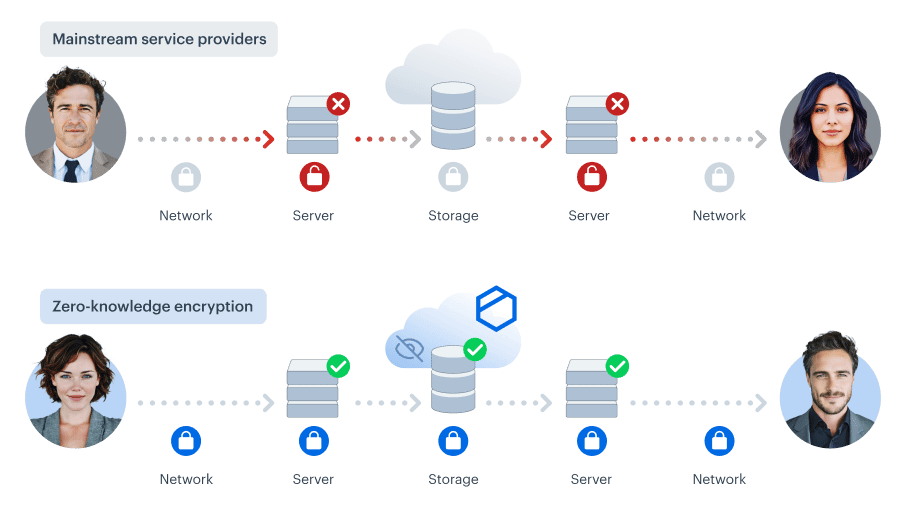
Storage space, share links, team features: At first glance, many cloud providers look similar. But behind the scenes, their security models vary dramatically. Traditional cloud providers, for example, manage your encryption keys. This enables broad integration but also means that access to content remains technically possible. Security-first cloud models take a fundamentally different approach: your data is encrypted before it is uploaded, giving you exclusive control over your data. When it comes to choosing a cloud you can truly trust, four factors make all the difference.
Security padlock-open

Encryption & protection

How early is your data encrypted?Many providers encrypt files only once they reach the server. Security-focused models encrypt content on your device - before upload. Earlier encryption means lower risk and no weak points in between.
Folder-Search

Provider access to content

Who can technically see your data? With server-side key management, access is possible in principle. With true client-side encryption, it is not. For companies handling sensitive customer data, this is not a minor detail. It is a core risk factor.
User check

Access rights

Security also means internal control. Who can access what across the organization? How granular are permissions? Are changes traceable? A professional cloud solution makes access rights transparent and manageable.
Cloud share

Secure sharing

Data is constantly in motion - internally and externally. The question is not whether sharing happens, but how securely. Password protection, expiration dates, download restrictions and activity logs are crucial when sharing confidential information.

What defines a truly secure cloud?

Not every cloud is created equal. Traditional solutions focus on productivity and collaboration. Modern secure cloud platforms prioritize protecting sensitive data.

Security is not a single feature - it's an architectural choice. In a high-security model, files are encrypted before they leave your device. The crucial question is: Who controls the keys? Ideally, not the provider.

A strong privacy architecture often involves trade-offs in terms of real-time collaboration. However, this doesn't mean teams must compromise on efficient workflows. Modern secure collaboration platforms combine granular permissions, secure sharing, and detailed activity tracking - all on top of a privacy-by-design architecture.

Tresorit is a leading security-first cloud platform. It delivers end-to-end encrypted content collaboration solutions for secure file sharing, storage, and digital workflows. Designed for organizations that handle confidential data. Files are encrypted before upload, keys remain under user control and security is integrated directly into the system design.
Comparison_page_infographic_biggerfont@2x

What defines a truly secure cloud?

Not every cloud is created equal. Traditional solutions focus on productivity and collaboration. Modern secure cloud platforms prioritize protecting sensitive data.

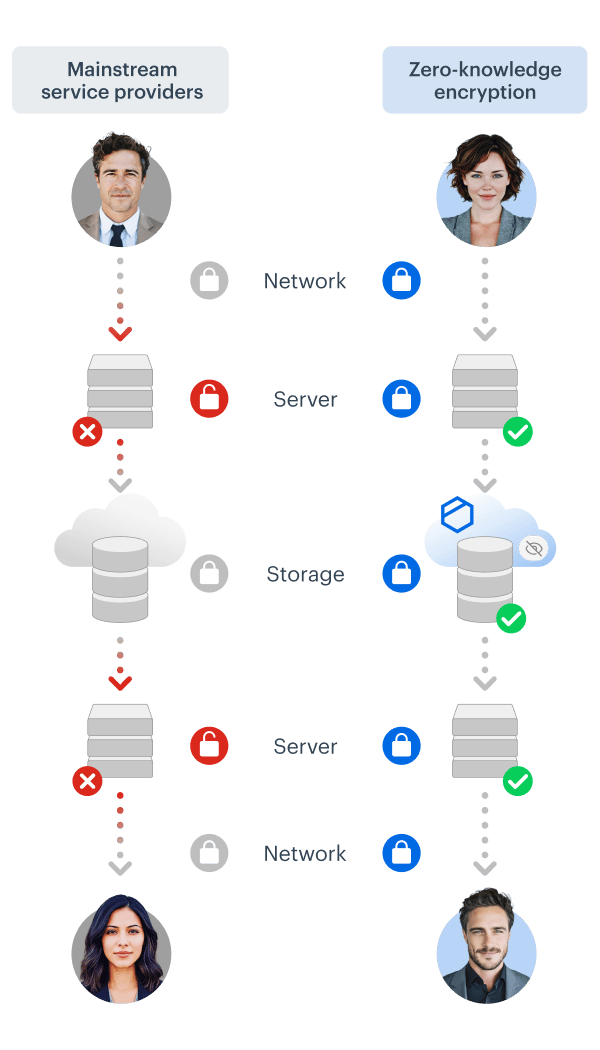
Security is not a single feature - it's an architectural choice. In a high-security model, files are encrypted before they leave your device. The crucial question is: Who controls the keys? Ideally, not the provider.

A strong privacy architecture often involves trade-offs in terms of real-time collaboration. However, this doesn't mean teams must compromise on efficient workflows. Modern secure collaboration platforms combine granular permissions, secure sharing, and detailed activity tracking - all on top of a privacy-by-design architecture.

Tresorit is a leading security-first cloud platform. It delivers end-to-end encrypted content collaboration solutions for secure file sharing, storage, and digital workflows. Designed for organizations that handle confidential data. Files are encrypted before upload, keys remain under user control and security is integrated directly into the system design.
Comparison_page_infographic_MB_EN@2x
Security architecture, control, and collaboration

Decision criteria for cloud platforms

The right cloud solution depends on how your organization uses and protects data. The question is not: "Which cloud is most popular?", but rather: "Which security model fits your risk profile?"

The deciding factor is who has technical access to unencrypted data. If you handle sensitive customer data, must meet regulatory requirements, or want to avoid any residual provider access, a security-first model is appropiate. If your data is less sensitive and integrations are your top priority, a traditional cloud may be sufficient.

Traditional cloud solutionsDropbox, Google Drive, Microsoft OneDrive, Apple iCloud, Egnyte, Box
Cloud storage with advanced encryptionCryptomator, NordLocker, Proton Drive
Security-focused cloud storageTresorit, Sync.com, MEGA, pCloud Crypto
    • Encryption
      Server-side encryption is standard; client-side options partially available
      Additional client-side encryption via tools or features
      Client-side, end-to-end encryption by default
    • Key control
      Mostly provider- or organization-managed
      Depending on the setup, partially user- controlled
      Zero-knowledge architecture, user-controlled keys
    • Technical provider access
      Possible depending on architecture
      Reduced, depends on setup
      Impossible for encrypted content (metadata remains partially visible)
    • Collaboration & integrations
      Extensive collaboration features & integrations
      Depends on base platform
      Collaboration available, security-focused
    • Suitability for sensitive data
      Possible with strong governance & compliance setup
      Suitable as an add‑on to existing clouds
      Designed for confidential and regulated data

FAQ - Secure cloud platform comparison

Secure cloud platforms are built on a fundamentally different security model.
They use client‑side, end‑to‑end encryption, ensure providers cannot access your content, and offer strict, controllable sharing mechanisms. Traditional cloud services prioritize convenience, collaboration, and ecosystem integrations - often relying on server‑side encryption, where the provider technically holds the keys.
With zero‑knowledge encryption, your files are encrypted on your device before they’re uploaded, and encryption keys never leave your control. This ensures that your provider cannot view, decrypt, or access your data - not even technically. This means that your data remains private at all times.
Encryption is crucial, but it’s only one part of a secure architecture. True security also depends on key control, access models, governance and transparency.
Yes, secure clouds support collaboration, but with a different approach.
Instead of prioritising real‑time co‑editing or large app ecosystems, they focus on controlled, traceable, and compliant workflows. Teams can share, review, approve, and work together efficiently, but always within a privacy‑first framework that protects sensitive data.
No. While content remains fully encrypted and inaccessible to the provider, technical metadata such as login, timestamps, device details must still be processed to operate the service securely.
A security‑first cloud is especially valuable for organisations that handle high‑risk or regulated data, such as legal, finance or healthcare institutions.
Yes, adding client‑side encryption tools can increase the privacy of data stored in traditional cloud platforms. However, these add-on solutions typically secure files only at specific moments and do not replace a purpose‑built secure collaboration platform.