4 min read



Legal collaboration works better when clients can actually see what is happening
Legal work has always been about people. Whether in a law firm or an in-house legal team, legal professionals help clients navigate complex situations, negotiate agreements, protect their rights, and manage risk. Every matter involves multiple stakeholders: clients, counterparties, external counsel, auditors, regulators, and internal decision-makers.
Yet despite the people-centred nature of legal work, collaboration with external stakeholders is often still fragmented.
Clients struggle to understand where a matter stands. Key updates disappear into long email threads. Responsibilities become blurred, deadlines slip, and sensitive documents end up spread across inboxes, shared folders and messaging tools. What should be a structured legal process turns into a patchwork of manual follow-ups and uncontrolled file sharing.
The result is not just frustration. It creates inefficiency for legal teams, a poorer client experience, and avoidable compliance and confidentiality risks.
Legal collaboration involves more than document exchange
Whether legal professionals handle a contract review, onboard a new client, manage litigation, or coordinate a regulatory investigation, it involves much more than simply exchanging files.
Tasks need to be assigned. Documents need to be reviewed and approved. Questions need answers. Deadlines need to be tracked. Stakeholders need visibility into progress. That is why legal collaboration is not simply about file sharing. It depends on task ownership, status visibility, approval workflows, document version control, and a clear record of who did what and when.
Many traditional collaboration tools were never designed to manage these processes effectively. As a result, legal teams spend valuable time coordinating work manually instead of focusing on higher-value activities.
At the same time, clients and external partners have come to expect a better experience. Trust remains essential, but it is no longer enough on its own. Today's clients also expect transparency, responsiveness, ease of use, and confidence that their sensitive information is protected.
Replacing uncertainty with transparency
One of the most common causes of friction in legal collaboration is uncertainty and lack of visibility.
Clients often ask:
- Where does this matter stand?
- Who reviewed the latest version?
- What is still outstanding?
- What happens next?
If legal teams have to answer those questions manually every time, the process is already too opaque.
Modern project-based data rooms solve this by giving each stakeholder a clear, relevant view of the matter. Documents, task lists, milestones, approvals, and updates sit in one place. Instead of chasing status by email, clients and external partners can see what is complete, what is pending, and what requires their action. Every action — whether it's uploading a document, approving a file, or leaving a comment — is recorded and traceable.
This matters operationally as well as relationally. Visibility reduces follow-up work, shortens response times, and helps legal teams keep momentum across matters with multiple participants.
Transparency in legal collaboration does not mean exposing everything to everyone. It means giving each stakeholder access to the information they need, at the moment they need it, with the right level of control.
That distinction is critical for legal work, where confidentiality must be preserved even when collaboration expands.
Structured workflows create efficiency
Many legal processes follow repeatable patterns: client onboarding, identity verification, due diligence requests, contract approvals, board consent collection, compliance checks, and post-signature follow-up.
Yet in many organisations, these processes are still managed through email reminders, spreadsheets, and disconnected tools. That approach is familiar, but it creates avoidable problems. Tasks get missed, wrong document versions get uploaded, access permissions are not updated quickly enough, and there is no single record of the process if questions arise later.
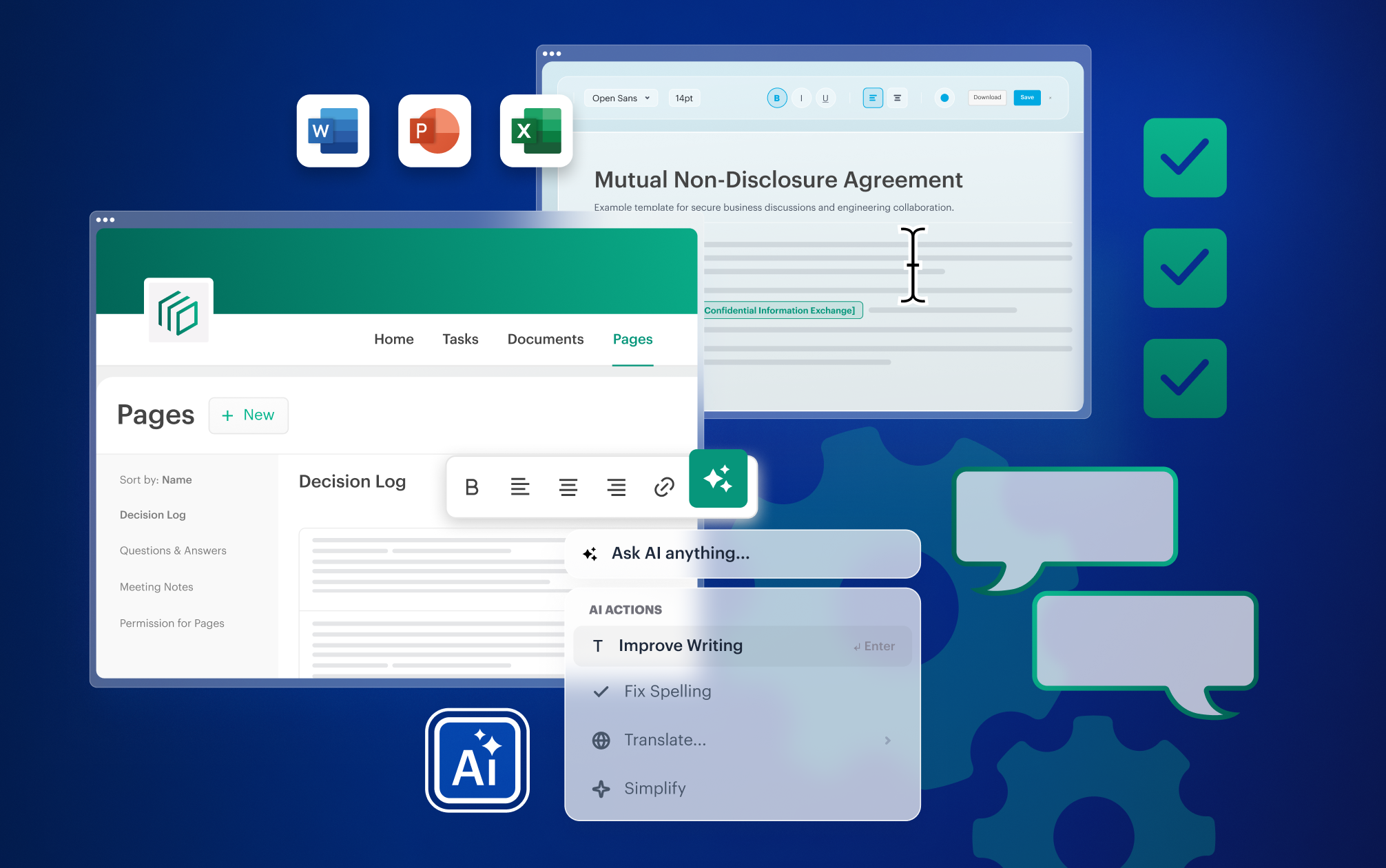
Modern encrypted collaboration tools help standardize these processes through customizable digital workspaces with predefined templates, tasks, role-based permissions, deadlines, and automated reminders. Reviews, approvals, document requests, and electronic signatures can all be managed within a single environment.
Instead of chasing updates and coordinating activities manually, legal teams can focus on delivering value.
Ease of use matters more than ever
A collaboration platform can be highly secure and still fail if clients, counterparties, or external advisers avoid using it.
For digital collaboration to succeed, external stakeholders must be able to participate without extensive training or technical expertise. The experience should feel intuitive from the first interaction.
If external stakeholders find a system difficult, they revert to email attachments, consumer file transfer tools, or ad hoc sharing links. That introduces shadow IT, weakens control, and makes it harder to maintain a reliable audit trail.
Ease of use is therefore not a “nice to have” in legal collaboration. It is part of maintaining secure behaviour.
Secure links, personalized portals, clear navigation, and straightforward workflows make it easy for clients and partners to engage with legal processes digitally.
When collaboration becomes simpler, adoption follows naturally.
This is especially important in high-trust but time-sensitive situations, such as M&A due diligence, internal investigations, employment matters, or contract negotiations involving external counsel and business stakeholders.
Better collaboration strengthens client relationships
There's a common misconception that digital collaboration creates distance between organizations and their clients. In practice, the opposite is often true when the process is designed well.
Clients feel more confident when they can see progress, understand what is expected of them, and access the latest documents without asking for updates. A well-structured collaboration space reduces ambiguity and makes the legal team look more organised, responsive, and in control.
When clients have clear visibility into progress, know exactly what is expected of them, and can easily access documents and updates, they feel more informed and more involved.
That experience matters. It shapes how clients judge both competence and service quality.
A branded collaboration space that reflects the firm's identity — with customized workspaces, welcome messages, and structured project areas — creates a professional and consistent experience. Documents can be reviewed, shared, approved, and signed within the same environment, reducing friction and improving communication.
Efficient collaboration leaves a lasting impression — and strengthens long-term client relationships.
Security is non-negotiable
Of course, none of these benefits matter if security is compromised.
Legal professionals handle highly sensitive information every day, from personal data and confidential business records to strategic legal documents. Protecting that information is not only a matter of good practice — it's a professional and regulatory obligation.
Modern project-based data rooms combine usability with strong security measures, including end-to-end encryption, zero-knowledge architecture, granular access controls, role-based permissions, and comprehensive audit trails.
This ensures that every matter remains confidential, access is controlled, and every action can be traced when needed.
Better collaboration starts with the right foundation
At its core, legal work is about helping people navigate important decisions and complex situations. The systems around that work should reduce complexity, not add to it.
For legal professionals working with clients, external counsel, auditors, counterparties, or regulators, project-based data rooms offer a more effective model than disconnected email and file-sharing tools. They improve visibility, structure repeatable workflows, support secure external collaboration, and provide the auditability that legal matters increasingly require.
Tresorit Engage fits this shift by giving legal professionals and teams a secure, encrypted, project-based collaboration environment built for controlled external engagement, not just document storage.
When legal collaboration is structured properly, clients get clarity, legal teams regain time, and confidentiality is easier to maintain.
Katalin Jakucs
View more articles from this author
Share this article