10 min read
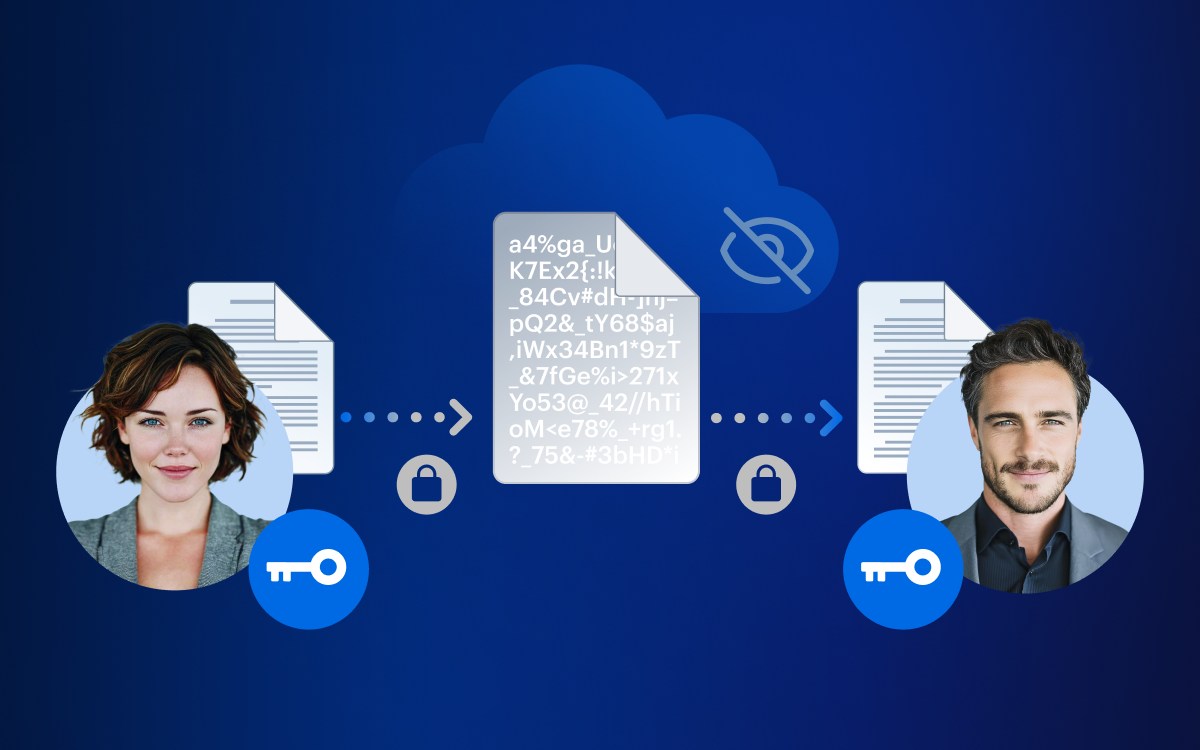


Encryption is often presented as a simple checkbox: “your data is encrypted.” In reality, how encryption is implemented determines who can actually access your files and whether your cloud provider remains part of the trust boundary.
This distinction becomes critical in cloud storage environments. In a real workflow, data does not simply travel from sender to receiver. It is created, edited, uploaded, stored, shared, downloaded, and reused. Each step introduces different exposure points depending on how encryption and key management are handled.
Understanding how end-to-end encryption (E2EE) works across this full workflow reveals why not all “encrypted” solutions provide the same level of protection. And why, in some cases, the provider can still access your data.
What is end-to-end encryption?
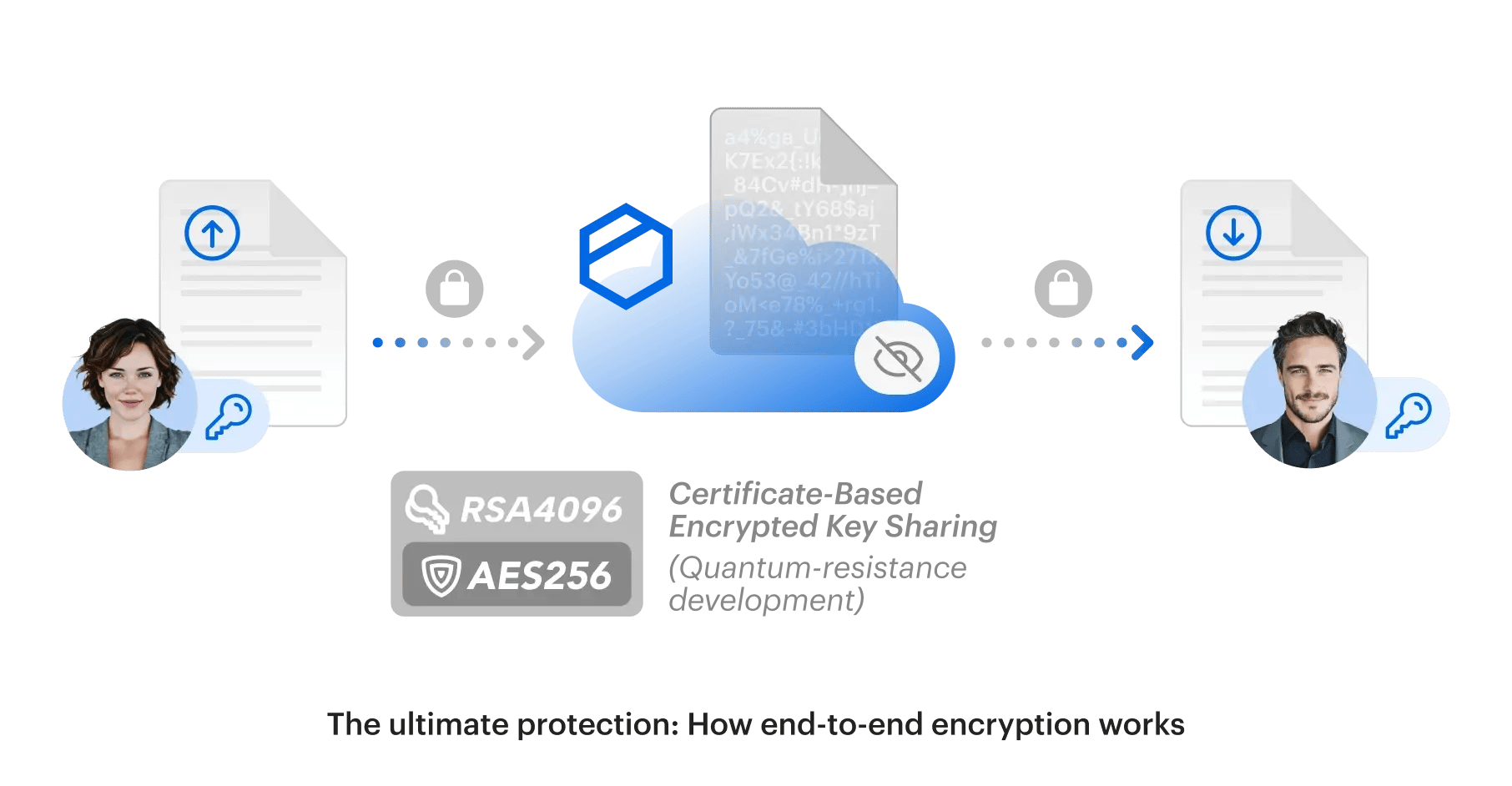
End-to-end encryption (E2EE) is a security model in which data is encrypted before it leaves the user’s device and can only be decrypted by authorized recipients. Because the encryption keys remain under user control, service providers cannot access file contents in readable form.
That is the principle. In cloud storage, however, the way it is implemented makes all the difference.
Why is this definition of end-to-end encryption problematic?
Most definitions of end‑to‑end encryption focus on transmission: how data moves between sender and recipient. That is incomplete. Because cloud storage is not just about moving data. Files are stored, synced across devices, shared with colleagues, opened in browsers, and often processed along the way. If encryption only applies to one stage, the system is not truly protected end-to-end.
A simple way to think about it: Protecting only the transfer is like securing the cargo trucks in a supply chain, but leaving the warehouse unlocked.
The majority of security risks in cloud storage do not happen while data is moving. They happen when data is stored, accessed, or shared.
Before going further: How encryption actually works
At its core, digital encryption protects information by transforming readable content into unreadable data. Only someone with the right key can turn it back into its original form.
Whether you are sharing a contract with a client, uploading financial documents to a cloud workspace, or sending sensitive data to an external partner, encryption is what prevents unauthorized parties from reading the content if they intercept or access it.
Today, most encryption relies on two main approaches:
-
symmetric encryption
-
asymmetric encryption.
These are not competing methods. Secure systems often combine them because each solves a different problem. Symmetric encryption is fast and efficient for protecting large files. Asymmetric encryption helps exchange access securely without exposing secret keys.
If you’ve opened a password‑protected PDF or submitted a form on through a HTTPS website, then – whether you realized it or not – you’ve already used these encryption methods. In fact, this process often happens multiple times in just a few seconds while you browse, log in, or upload a file.
Interested in how encryption evolved from ancient ciphers to modern cloud security? Explore our guide to the history of encryption.
Understanding how these two methods work together is key to understanding how modern end‑to‑end encrypted solutions protect your data in practice.
What is symmetric encryption, and how does it work?
Symmetric encryption uses one key to both encrypt and decrypt data. The sender locks the data with that key, and the recipient uses the same key to unlock it. In everyday terms, it works like a physical key: the same key locks the door and unlocks it.
In digital systems, key strength is usually measured by key length, commonly 128, 192, or 256 bits. One of the most widely used symmetric encryption standards today is AES, or Advanced Encryption Standard.
Symmetric encryption is widely used because it is fast. That makes it well suited for encrypting large files, folders, and stored data in cloud environments.
What makes symmetric encryption useful?
The strength of symmetric encryption comes from its simplicity.
- It is fast, which makes it ideal for encrypting large files
- It requires less computing power than more complex methods
- It is widely tested and trusted across industries
This is why symmetric encryption is often used to protect files in cloud storage and collaboration systems once access has already been secured.
Where symmetric encryption falls short?
That same simplicity also creates its biggest weakness: the same key must be available to everyone who needs access to the encrypted data.
If that key is exposed, everything encrypted with it becomes accessible. This can happen in several ways:
-
Storage: the key is kept on an insecure device or in a vulnerable system.
-
Transmission: the key must be shared with another user and could be intercepted if the exchange is not properly secured.
-
Brute-force attacks: given enough time and resources, attackers may attempt repeated guesses to break weak or poorly protected keys.
These risks become more difficult to manage in cloud collaboration environments, where files are shared across multiple users, devices, and locations. The more places a key needs to exist, the larger the potential attack surface becomes.
There are also operational challenges:
- Key distribution: securely sharing the same key with multiple users becomes increasingly complex as teams grow.
- Key lifecycle management: updating, rotating, or revoking access is difficult when everything depends on a single shared secret.
This is why symmetric encryption alone is rarely sufficient for secure communication or collaboration. It excels at protecting data efficiently, but it needs a secure way to exchange access without exposing the encryption key itself. That is exactly the problem asymmetric encryption was designed to solve.
What is asymmetric encryption, and how does it work?
Asymmetric encryption was designed to solve a fundamental challenge in security: safely sharing access without exposing a secret encryption key. Instead of using one shared key, it uses two mathematically related, but not interchangeable keys:
- a public key, which is shared
- a private key, which is kept secret
Here’s how it works in practice:
-
The recipient shares their public key
-
The sender uses that public key to encrypt the data
-
Only the recipient can decrypt it using their private key
Even if someone intercepts the encrypted data – or the public key – they still cannot read the information without the private key.
What makes asymmetric encryption useful?
This approach solves the biggest weakness of symmetric encryption: key sharing. Because no secret key needs to be transmitted, asymmetric encryption makes it much safer to exchange sensitive data across networks. That’s why it’s widely used to:
- enable secure communication without sharing secret keys
- support authentication, ensuring both sides are who they claim to be
- allow digital signatures, verifying the integrity and origin of data
- Even if a public key is exposed, it cannot be used to decrypt the data
In cloud collaboration environments, asymmetric encryption plays a critical role because it allows users to share encrypted files securely while keeping decryption keys under the control of authorized recipients.
Where asymmetric encryption falls short?
-
Performance and speed
Because it relies on complex mathematical calculations, asymmetric encryption is slower and more resource-intensive. This makes it inefficient for encrypting large files or handling high volumes of data on its own. -
Key management complexity
Security depends on how well private keys are stored and managed. If a private key is lost, access to data is lost. If it’s stored insecurely—or handed over to third-party systems—security depends on those systems as well. -
Trust and verification challenges
Public keys are meant to be shared, but that creates a risk: If users cannot verify that a public key belongs to the intended recipient, an attacker could impersonate that person by providing a fake key. This is the basis of a man-in-the-middle attack.
What this means in practice
Because of these trade-offs, asymmetric encryption is rarely used on its own. Instead, modern systems combine both approaches:
- asymmetric encryption to securely share access and establish trust
- symmetric encryption to encrypt data efficiently and at scale
For end-to-end encrypted cloud storage, this combination is essential. The system must protect file content, manage keys securely, and allow authorized users to collaborate without exposing data to the provider.
What encryption are used in cloud storage?
When providers talk about encryption, they’re usually referring to different points in the lifecycle of your data. The most common approaches are:
- encryption in transit
- session encryption
- encryption at rest
- client‑side encryption
- End-to-end encryption
Each solves a different problem. The catch is that none of them on their own tells you who can actually access your data in readable form?
|
Encryption type |
What it protects |
Typical provider access |
|
Encryption in transit |
Data moving between systems |
Provider may still access data after arrival |
|
Encryption at rest |
Data stored on servers |
Provider often controls decryption |
|
Session encryption |
A temporary communication session |
Protection usually ends when the session ends |
|
Client-side encryption |
Data before upload |
Depends on who controls the keys |
|
End-to-end encryption |
The full file lifecycle between authorized users |
Provider should not be able to access readable content |
Illustrative scenario: Let's imagine you're travelling with highly confidential business documents. You need to transport them safely, discuss them with trusted colleagues, store them securely, and eventually share them with a business partner.
.png?width=1208&height=800&name=V1A-EN-Decrypting%20the%20jargon%20behind%20end-to-end%20encryption%20(2).png)
Encryption in transit
Encryption in transit protects data while it’s moving between systems (your device and the cloud, or one service and another). This is what happens when you upload a file, open a document in your browser, or submit a form over HTTPS.
Its purpose is to prevent third parties from intercepting and reading data while it is travelling across networks.
Returning to our scenario: This is like transporting your documents through a secured route (say, a taxi or a guarded vehicle) instead of walking them through a crowded street. The journey is protected, but the protection ends once the documents arrive.
Session encryption
Session encryption protects communication during a specific interaction between two systems. For example, when a browser connects to a secure website, both parties establish trust, agree on temporary encryption keys, and protect information exchanged during that session.
In our hotel example, you've now arrived and need to discuss the documents with a colleague. Instead of meeting in the hotel lobby, you reserve a private meeting room where the conversation cannot be overheard.
But here’s the limitation: Once the session ends – or once data is stored – this protection no longer applies. Any documents stored afterward need their own form of protection.
Encryption at rest
From a traditional security perspective, it’s easy to focus on protecting data while it’s moving.
But what about when it reaches a server? That’s where encryption at rest comes in. It protects data after it has been stored on a server or storage system. For example, when you send a message through an app, it doesn’t just pass through a server. It’s stored somewhere so it can be accessed later.
That’s why at‑rest encryption is essential. It protects data from being directly accessed at the infrastructure level, but it also raises an important question: Who can still access it?
Let's come back to our scenario: After your meeting, you want to find a safe place to leave your sensitive documents while you step out. You lock them in your hotel room. The room is secured, the building has security measures in place, and access is controlled. But the hotel still manages the property. Staff may have master keys, maintenance personnel may need access, and the hotel ultimately controls who can enter the room.
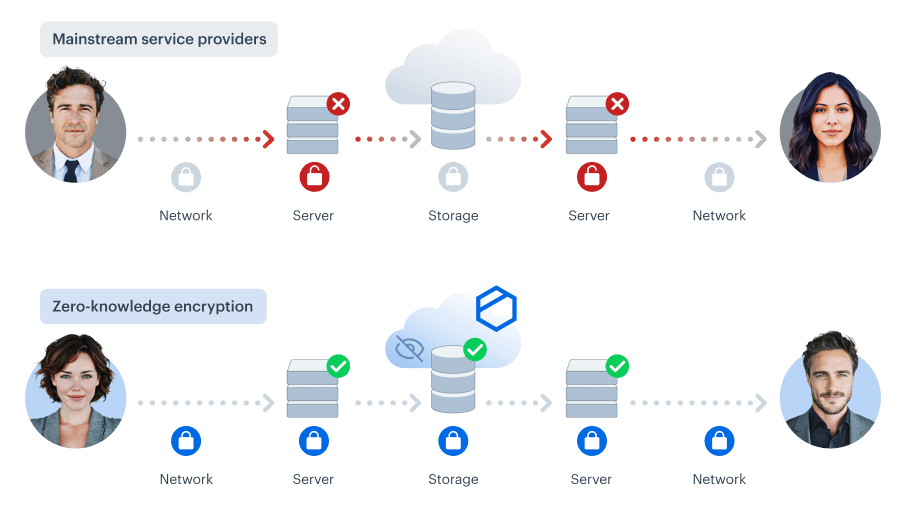
This is similar to encryption at rest. The data is protected while stored, but the organization managing the storage environment may still be able to access it. In many cloud services, providers control the encryption keys and can decrypt data when needed to support features such as search, previews, indexing, or integrations.
Client-side encryption
Client-side encryption moves protection one step earlier: Instead of relying on the cloud provider to encrypt your files after upload, files are encrypted on the user's device before they leave it.
This means encryption in transit and encryption at rest become additional layers of protection, rather than the first line of defense.
From a security perspective, this is one of the strongest approaches because it reduces the number of places where data exists in readable form. Even if someone gains access to the storage environment, they still cannot read the contents without the right key.
In our scenario: Rather than placing documents directly in the hotel room, your first lock them inside your personal safe. The hotel can store the safe in your room, move it if necessary, and provide security around it – but it cannot see what's inside.
But security is only half of the equation. The real challenge is usability.
Teams still need to share files, revoke access, collaborate with external partners, recover access when devices change, and maintain control over who can read what. Historically, strong client-side encryption often required users to manage keys manually or rely on specialist tools such as PGP. Security was strong, but collaboration was difficult.
Modern secure collaboration platforms take a different approach. They combine client-side encryption with built-in key management, access controls, and sharing workflows, so teams can work securely without becoming cryptography experts.
From client-side encryption to end-to-end encryption
At this point, client-side encryption sounds like the ideal solution. If files are encrypted before they leave your device, what's missing? The answer lies in everything that happens after encryption.
The moment you start collaborating, new questions appear:
- How are encryption keys exchanged?
- How is access granted to the right people?
- How are keys stored and backed up?
- Can anyone besides the intended recipient access the data?
In other words, securing the file itself is one thing. Securing the entire workflow around that file is another. This is where end-to-end encryption comes in.
Let's come back to our example: Your documents are locked inside your own briefcase. A trusted business partner now needs access to them. The hotel can help deliver the briefcase, but it cannot open it or see what's inside.
What does a truly end-to-end encrypted system require?
At Tresorit, we think of end-to-end encryption as the natural evolution of client-side encryption. It's not just about encrypting files before upload. It's about ensuring that only the intended users can decrypt them throughout their entire lifecycle.
In practical terms, an end-to-end encrypted system should ensure that:
- Only the intended participants can decrypt the data. Files are encrypted at the source and only decrypted by authorised recipients. The provider should not be able to read the content in plaintext.
- Encryption keys remain under user control. The provider should not be able to read the content in plaintext. If a third party can access the keys—even temporarily—the protection is no longer fully end-to-end.
- Keys are exchanged securely. Users need a way to share encrypted files without exposing encryption secrets during the sharing process.
- Users can verify who they are sharing with. Encryption is only effective if you're confident the public key belongs to the person you intended to communicate with.
Client-side encryption protects where data is encrypted. End-to-end encryption extends that protection across sharing, access, and collaboration, ensuring files remain protected throughout their lifecycle.
End-to-end encryption and zero-knowledge encryption
End-to-end encryption and zero-knowledge encryption are closely related, but they describe different aspects of data protection.
End-to-end encryption focuses on who can decrypt the data. Only authorized users should be able to access content in readable form.
Zero-knowledge encryption focuses on what the provider can know. In a zero-knowledge system, the provider stores and synchronizes encrypted data but does not have access to the keys required to decrypt it.
In practice, secure cloud collaboration platforms often combine both approaches. End-to-end encryption protects sharing and collaboration workflows, while zero-knowledge architecture ensures the provider remains unable to access customer data.
If you'd like to explore how zero-knowledge architecture work in more detail, read our guide to zero-knowledge encryption.
Why does E2EE matter for businesses?
Business information rarely stays in one place. A file may be shared with colleagues, external partners, customers, auditors, and legal advisors throughout its lifecycle. Every handoff introduces questions of access and trust.
Without end-to-end encryption, providers may still be able to decrypt files to support certain features. That may be acceptable for low-risk content but can become a concern for sensitive information. For regulated organizations, E2EE helps reduce unnecessary third-party access to sensitive information, supports compliance and data sovereignty, and enables secure collaboration.
It can also help address shadow IT. When secure tools are difficult to use, employees often turn to consumer file-sharing services, email attachments, or unmanaged cloud folders. Combining end-to-end encryption with usable collaboration features makes it easier for teams to work securely without creating workarounds.
Learn more about Why you need cloud storage with end-to-end encryption.
From encryption to secure collaboration
End-to-end encryption is most effective when it becomes part of everyday workflows, not an obstacle to them. Tresorit combines end-to-end encryption, zero-knowledge architecture, and usability to help organizations collaborate efficiently while maintaining control over sensitive information.
Learn more about how Tresorit SecureCloud enables secure sharing and collaboration inside and outside your organization.
This article was originally published in November 2022 and updated in July 2026 to ensure accuracy and relevance in today's cloud security and collaboration landscape.
Share this article