3 min read



Whether it’s client onboarding, lending, or audits, financial processes are designed to follow clear steps and responsibilities. In reality, however, they often break down the moment external stakeholders get involved. Documents are sent back and forth via email, progress remains unclear, and decisions get scattered across inboxes and chat tools – slowing things down and exposing sensitive data to risk.
For banks, wealth managers, insurers, and lending institutions, this creates more than operational inefficiency. It affects compliance, responsiveness, and ultimately client trust. Traditional file-sharing tools were never designed for this level of collaboration complexity. Financial institutions increasingly need environments that support the workflow itself - securely, transparently, and end to end.
Onboarding: where theory meets reality
It’s Monday morning. A relationship manager at a private bank starts onboarding a new high-net-worth client. She sends an email with a list of required documents: passport, proof of address, tax information, income statements.
A few hours later, responses trickle in: one document is attached directly to the email, another is shared via a cloud link, and a third is still missing. By midday, compliance follows up in a separate chat: “Is this the latest version? Page 3 seems incomplete, can you ask the client to resend it?”
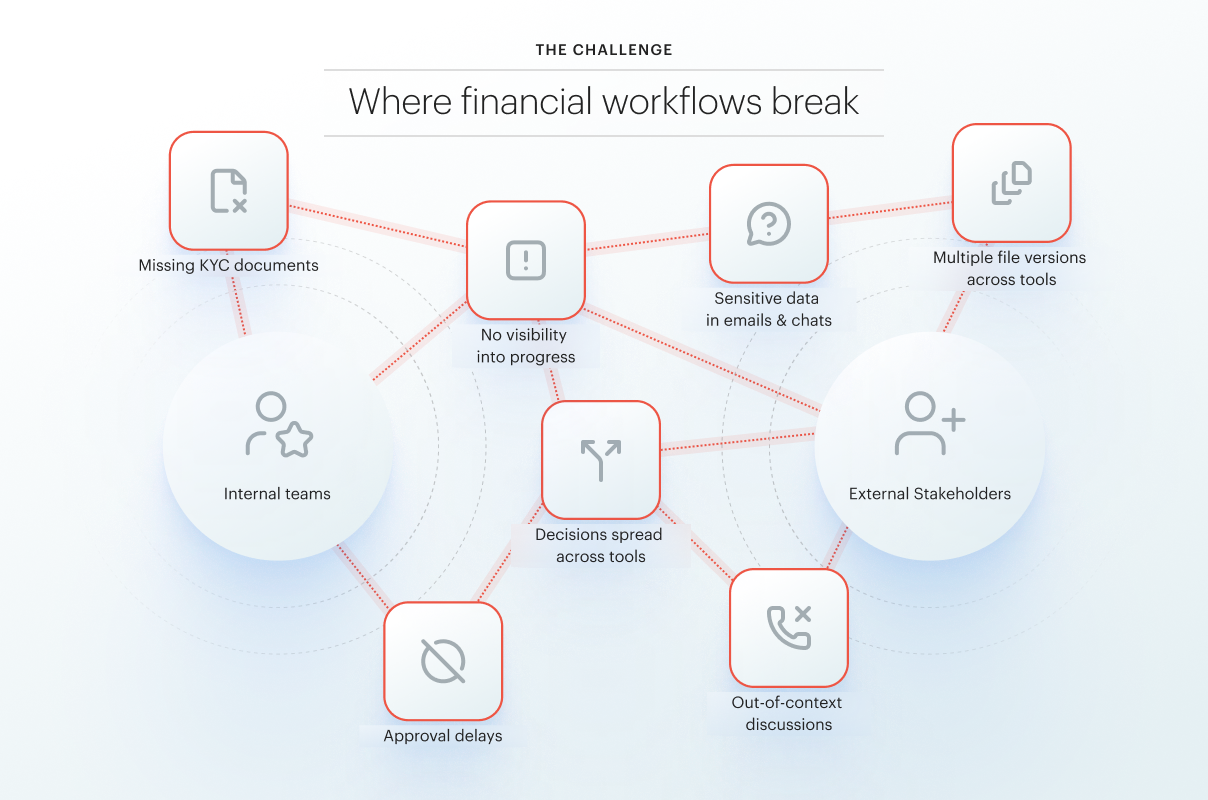
By the end of the day, what should have been a structured onboarding workflow already feels difficult to coordinate:
- multiple parallel email and chat conversations
- clarifications and decisions scattered across tools
- no clear overview of documents, missing items, or latest versions
And this moment matters. For many clients, onboarding is the first meaningful operational interaction with a financial institution. If the experience feels disorganized or slow, trust begins to erode before the relationship has fully started.
From fragmented tools to structured workflows: Why encrypted data rooms matter
Many financial teams still rely on a mix of disconnected tools that were never designed for highly regulated client and partner collaboration. File-sharing platforms, email, spreadsheets, chat applications, and external editors all operate separately, forcing teams to bridge the gaps manually.
Workflow-oriented data rooms like Tresorit Engage take a different approach. Instead of adding another tool to the stack, they bring file exchange, workflows, and communication into one secure environment. This allows teams to build structures around real processes:
- Guided onboarding workflows from document submission to final sign-off
- Structured credit review and approval workflows
- Streamlined contracting - drafting, reviewing, and signing – without tool switching
- Simplified audits with controlled access and full activity tracking
Collaboration designed for external stakeholders
For clients, auditors, and external partners, the collaboration experience shapes how they perceive the entire organization. If processes feel confusing or difficult to follow, confidence drops quickly.
Secure client and partner portals create a more intuitive experience. Instead of sending files multiple times via email or navigating confusing folder structures, they follow a guided process with tasks, deadlines, and discussions embedded directly in the workflow. Access is simple and requires no technical hurdles, while branded data rooms provide a consistent, professional brand experience that strengthens long-term relationships.
Security & compliance – built in, not added on
In financial services, security risks rarely come from a single dramatic failure, but from the gaps of everyday collaboration – especially when sensitive information moves across internal and external stakeholders without clear visibility or traceability. That’s why regulations such as DORA, MaRisk, NIS2, and GDPR, increasingly require not only secure systems, but also transparent and traceable workflows.
Encrypted data rooms address both by embedding security and compliance directly into collaboration:
- Zero-knowledge end-to-end encryption protects data at all times
- Access is strictly role-based and controlled
- All actions are automatically logged and fully traceable
This eliminates security gaps caused by workarounds or media breaks. Every interaction – from the first upload to final approval – remains protected and transparent.
A better way to onboard clients
Now imagine the same onboarding process, but this time, nothing feels messy. Instead of drafting yet another email, the relationship manager creates a new client portal using a predefined template in seconds. The onboarding flow is clearly laid out from the start – with tasks, responsibilities, timelines, and required documents.
The client doesn’t dig through an email for instructions. They enter a secure, branded workspace where the process immediately feels easy to follow. At the same time, everything moves in sync behind the scenes:
- The relationship manager tracks progress in real time.
- Compliance reviews documents as they arrive.
- And contracts can be signed in the same flow – no switching tools, no workarounds.
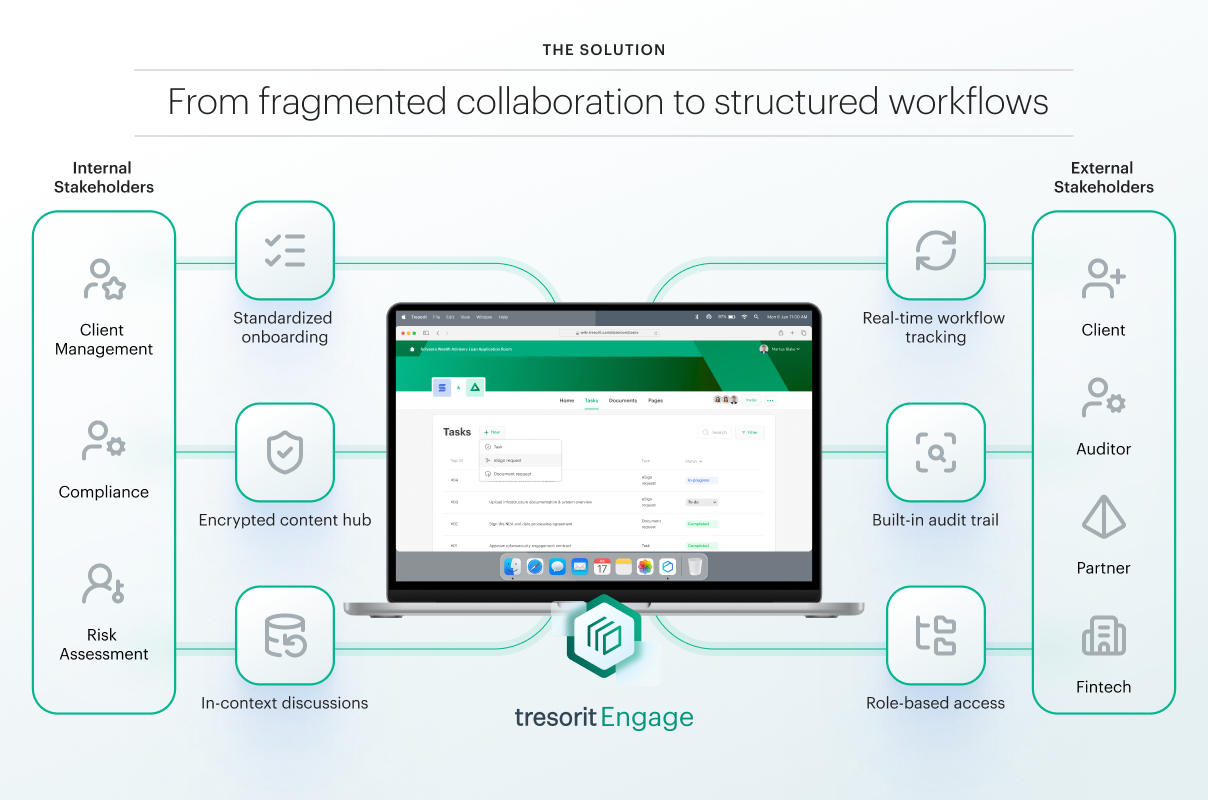
From onboarding to end-to-end financial workflows
What makes this approach powerful is that onboarding is only the beginning. The same structured logic can be applied across other financial workflows.
After onboarding, for example, the client applies for credit. Instead of restarting coordination via email, required documents are already there. Approvals move forward in a clear, traceable flow. And when it’s time to finalize, the contract is signed right where the work happens.
The same applies during an audit. What used to trigger last-minute scrambling now feels routine: Documents are already organized, access for auditors is controlled, and every interaction is automatically logged.
What has started as a smoother onboarding experience evolves into a consistent way of working across the entire client journey.
Workflow beats file sharing
In financial services, the challenge is no longer simply storing data securely. It’s about making complex workflows transparent, traceable, and easy to manage across teams, clients, auditors, and external partners.
Encrypted data rooms eliminate the root cause of inefficiency: disconnected collaboration. They bring together documents, workflows, communication, and approvals in one secure, and user-friendly environment. One that supports real financial workflows from onboarding to credit approvals, audits, and beyond. And in a trust-driven industry, that makes all the difference - from the very first interaction.
Turn fragmented processes into seamless workflows. See how encrypted, workflow-driven data rooms can transform onboarding, audits, and client collaboration in financial services from day one.
Share this article