5 min read



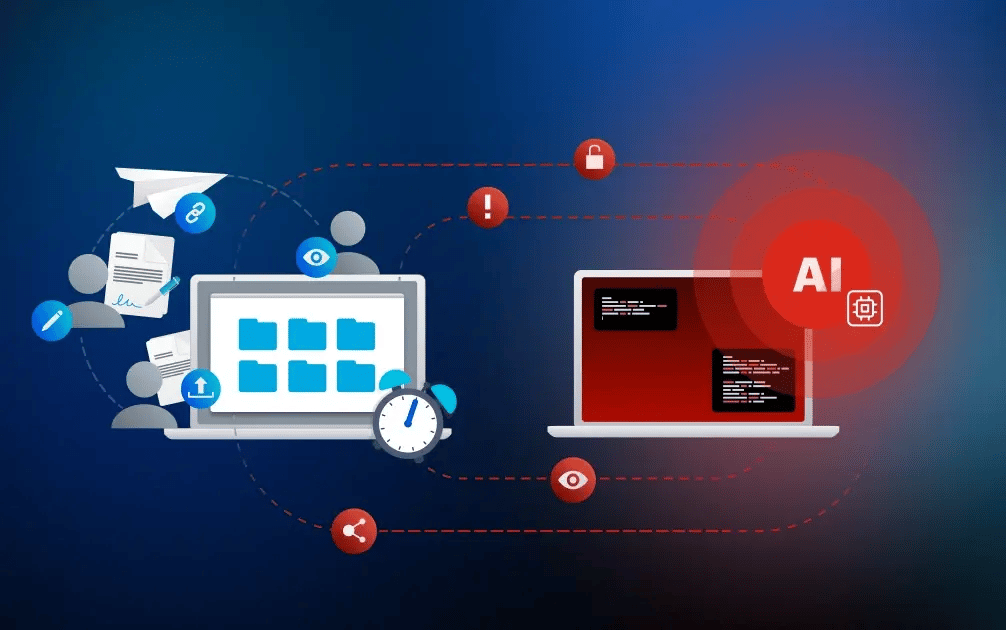
Artificial Intelligence has moved from hype to everyday reality. What once felt futuristic is now embedded in email systems, cloud storage, and collaboration platforms. Today, AI touches nearly every workflow. But as AI analyzes, classifies, and learns from data, businesses face an unavoidable question: Where should AI be allowed to access information and where is excluding it a strategic decision?
For sensitive or highly regulated workflows, the answer is clear. And this isn’t about rejecting innovation. Far from it. AI helps teams work faster, communicate smarter, and automate the tedious parts of everyday tasks. Yet when security, confidentiality, and compliance are business-critical, companies must draw firm boundaries.
Unsurprisingly, a counter-movement is also emerging. CNN labeled 2026 the year of “anti‑AI marketing”, reflecting a broader shift in sentiment. Businesses are rediscovering the value of deliberately human‑controlled digital spaces that guarantee no AI – no scanning, no training, no background analysis – is touching their sensitive data. The motivation is clear: organizations want to regain control over critical workflows, because allowing algorithms to “handle it” carries too much risk. The good news: AI-free workspaces do exist and they are making a comeback.
The AI shock: Why companies are reconsidering
The urgency is clear: The risks of AI are becoming impossible to ignore. Many mainstream cloud platforms now automatically scan, analyze, and categorize user data to power AI features. For businesses handling sensitive information, this creates new legal, regulatory, and trust challenges.
At the same time, AI-related incidents are rising sharply. In 2025 alone, the AI Incident Database recorded 346 harmful events – from deepfakes and large-scale fraud to dangerous AI hallucinations and misleading AI-generated advice. Experts suspect the real number is even higher.
Even well-protected AI applications can create security gaps. Companies relying on AI vendors may be exposed to geopolitical or regulatory pressures beyond their control. With new AI regulations emerging worldwide, from the EU AI Act to state-level transparency rules in the U.S., the compliance burden is only growing.
As a result, AI-free applications are gaining attention, not just to reduce risk, but to eliminate it wherever necessary.
What are AI-free workspaces and why do they matter?
AI‑free workspaces are digital environments where AI is intentionally excluded and therefore cannot access data – neither for scanning, classifying, nor processing. Technically, these workspaces rely on privacy-first system architecture, including end-to-end encryption and zero-knowledge principles that prevent any system, hacker, cloud provider, or AI model from accessing plaintext data.
Why are these workspaces so relevant? Because high-stakes data demands strict boundaries - whether due to legal obligations, confidentiality requirements, or the strategic value of the information itself. Regulated sectors like finance, healthcare, legal, and IT handling sensitive workflows cannot risk accidental AI exposure. Because even the smallest automated analysis could reveal metadata, patterns, or sensitive context that was never meant to be processed. As AI becomes deeply embedded in everyday tools, these protected, AI-free zones restore what regulated organizations need most: security, compliance, and trust.
Real-world uses cases for AI-free workspaces
- Legal workflows: Safeguard client files, case collaboration, and contracts from AI processing.
- Finance workflows: Protect financial models, planning documents, and forecasts from exposure to AI.
- IT services: Collaborate on system designs, infrastructure plans, or security documentation without risk.
- HR processes: Secure employee records, performance reviews, and salary information.
- Healthcare workflows: Keep patient records, clinical notes, and medical research fully confidential.
AI-friendly vs AI-free: AI where you want it, privacy where you need it
Important to note: AI‑free does not mean anti‑AI. It means companies can decide where AI adds value and where it isn’t allowed to look. For example, AI can streamline routine, non-sensitive workflows – from email sorting, content editing, or meeting summaries.
Alongside these everyday AI-powered workflows, zero-knowledge end-to-end encrypted platforms enable businesses to create an extra layer of security for sensitive data exchanges and collaboration – untouched and unobserved by AI and fully under the organization's control. In these AI‑free workspaces collaboration continues to flow seamlessly – both with internal teams and external parties – while sensitive information stays fully protected.
The core benefits of AI-free, zero-knowledge tools:
- Full control over data. Neither AI nor the provider can access your content.
- No model training. Data is never fed into AI models, where usage purposes are often unclear.
- No profiling: User activity is not analyzed, evaluated, or stored for algorithmic purposes.
- Compliance by design. Privacy is not a feature, it’s the foundation of architecture.
Checklist: the 5 must-have features of AI-free, privacy-first solutions
What should organizations look for in an AI-free, secure collaboration platform? Here’s a practical list of the features that matter most.
#1 AI‑free by design
Privacy-first platforms should ensure sensitive content is never scanned, processed, or used for AI training.
☐ No generative AI features are integrated - text, image, or speech analysis - not even optionally
☐ Transfer of data to external AI services is contractually excluded
☐ No data processing for training, optimization, or analytics
☐ No automatic metadata enrichment or user profiling
☐ Full transparency over all data flows and processing
#2 End‑to‑end encryption and zero‑knowledge principles
Data must remain private and secure throughout the entire file exchange – both while it’s being transferred (in transit) and when it’s stored (at rest). Client‑side end‑to‑end encryption guarantees exactly that. Every file is encrypted before it leaves the user’s device. Because the encryption keys remain solely with the user, even the provider cannot view, modify, or enrich the information with synthetic information.
☐ Data is encrypted on the user device before transmission
☐ Data is encrypted during transmission and storage
☐ Only authorized users have access to decryption keys
☐ The provider is technically unable to view plaintext
☐ Encryption is enabled by default, not optional
#3 Granular access controls
Fine‑grained access controls ensure that only authorized individuals can view sensitive content and prevent accidental or automated AI exposure. This reduces internal and external risks in file sharing and supports compliance with the least‑privilege principle.
☐ Access rights can be assigned by role, user, or project
☐ Password protection, expiry dates, and other security controls are available for shared content
☐ Access permission can be revoked at any time
☐ Controls for disabling forwarding, download, or copying content are in place
☐ Events and changes are logged automatically and in a tamper‑proof manner
#4 Metadata minimization
Metadata often reveals more about behavior and context than users expect. The requirement is to store only the minimum metadata necessary. This reduces the risk of sensitive data slipping into AI models and minimizes the attack surface.
☐ Only strictly necessary metadata is retained
☐ Behavioral analysis and usage profiling are completely excluded
☐ All stored metadata is visible, user‑controllable, and deletable on request
☐ No contextual data is aggregated without necessity
☐ All metadata processing purposes are clearly documented
#5 Post‑quantum cryptography (PQC)
Post‑quantum cryptography is part of a forward‑looking security architecture, ensuring that today’s encrypted data cannot be decrypted by tomorrow’s quantum computers.
☐ A clear roadmap for migrating to quantum‑resistant algorithms
☐ Use of post-quantum-resistant cryptography
☐ Architecture supports a hybrid transitional phase
☐ Long‑term sensitive data is protected against “harvest now, decrypt later” tactics
☐ Compliance standards and certifications are transparently documented
The future of secure collaboration: AI-free workspaces by design
While no one denies the productivity gains of AI, high-risk collaboration requires more than innovative tools. In moments where confidentiality and compliance matter, companies need environments that preserve human oversight and eliminate unnecessary digital risk.
Tresorit has embraced this privacy-first approach from the start: The platform is built on zero-knowledge end-to-end encryption that is AI-free by design. This ensures that only users - not providers, algorithms, hackers, or governments - can access information. With a long‑term commitment to security and a proactive transition to post‑quantum cryptography, Tresorit ensures that organizations retain control over their most sensitive information today and long into the future.
Need to protect your business-critical workflows from AI exposure? Discover how Tresorit's zero-knowledge end-to-end encrypted platform help you create an added layer of security for your most sensitive data flows - fully under your control.
Brigitta Finta
View more articles from this author