5 min read


In 2026, artificial intelligence is an established part of everyday operations in many organizations. While this creates efficiency, it also presents companies with new challenges in terms of security and data control. At the same time, traditional threats remain relevant in evolving forms and continue to shape the cybersecurity landscape.
In many organizations, there is still no clear or formal policy governing the use of AI — particularly when it comes to processing sensitive information in external systems. And yet, this is exactly what happens every day. Employees use AI to draft texts, summarize information, or prepare decisions. It is fast and efficient — but not without risk.
The greatest risks rarely arise from spectacular attacks. They begin in everyday situations — with a login, a prompt, or a file that is “quickly uploaded.” As AI becomes a natural part of business processes, it often remains unclear which data flows into external systems and who retains control over it.
Against this backdrop, several developments are emerging for 2026 that companies should strategically take into account.
AI adoption vs. governance – When speed outpaces control
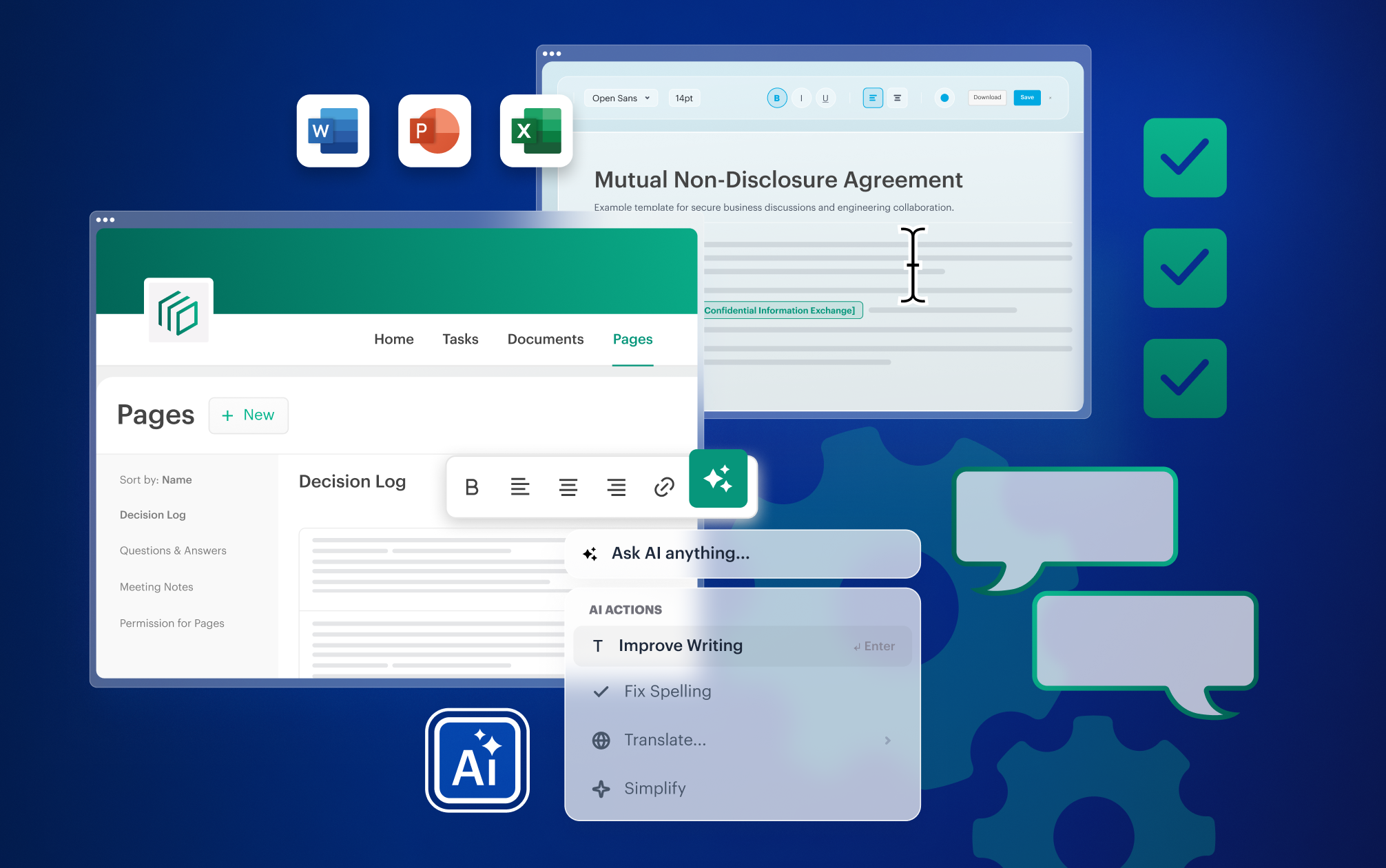
In 2026, AI has become an integral part of many operational business processes. Large language models generate content, while other AI systems support analytics, automate workflows, and prepare decisions. What is still used selectively today will evolve into a standard tool in everyday work. However, implementation often takes place in a decentralized and pragmatic manner — without formal approvals, clear policies, or comprehensive risk assessments.
This is where a structural imbalance arises. While AI usage increases rapidly, governance structures, transparency requirements, and security assessments struggle to keep pace. As a result, many organizations struggle with limited visibility into unmanaged AI usage, which data flows into them, where that data is processed, or how long it is stored.
This further intensifies the tension between efficiency gains and loss of control. While the functional benefits of integrated AI are obvious, uncertainty about data flows and responsibilities increases.
Security must therefore move beyond protecting individual systems and instead focus on where data is created, shared, and processed. Especially when sensitive or business-critical information is involved, data sovereignty becomes the key prerequisite. In practical terms, data sovereignty means that organizations retain full control over where their data is stored, who can access it, and under which legal jurisdiction it is processed — ensuring that sensitive information remains protected from unauthorized access and external dependencies.
Shadow AI – When AI operates outside the security architecture
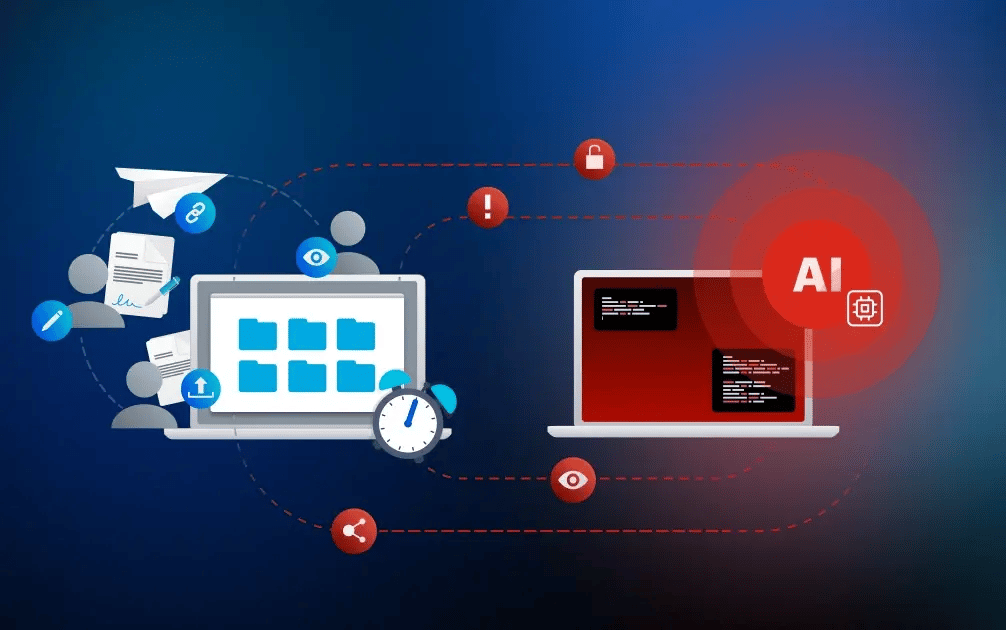
The use of software outside corporate infrastructure entered the security discourse years ago under the term “shadow IT.” In a similar way, the concept of “shadow AI” is now emerging. It refers to the use of AI tools without the knowledge or approval of IT and security teams. While these phenomena are comparable in principle, shadow AI carries significantly higher data risks.
Whereas traditional shadow IT often involves additional applications or cloud services, AI typically accesses content directly. Generative AI tools may be used to review contracts, analyze customer data, or structure internal strategies — often without transparency regarding how the data is processed or where it is stored. For example, an employee might upload an internal strategy document to a public AI assistant to summarize key points or draft a presentation. If the tool processes or retains this information outside the organization’s controlled environment, sensitive business data could unintentionally be exposed. . Depending on provider policies and contractual terms, some AI services may store or use inputs for analytics or model improvement unless explicitly disabled. In all such cases, sensitive information may leave the controlled corporate environment. This creates elevated risks of data leakage, compliance violations (for example under the GDPR or industry-specific regulations), and unwanted dependencies on third-party providers.
At the same time, traditional perimeter-based security models are reaching their limits. The assumption that everything within the corporate network is controlled and secure no longer holds when data is processed through external AI services.
Identity as the primary attack vector
In 2026, the majority of successful cyberattacks will still begin with compromised credentials. Despite new technologies and AI-powered defense mechanisms, identities remain the central attack surface — both at the human and technical level.
Phishing and social engineering, reused passwords, and insufficiently implemented multi-factor authentication continue to be among the most common causes of successful breaches.
However, while the entry points are well known, AI will change the quality of these attacks. Attackers use AI-powered systems to craft phishing messages that are linguistically convincing and highly contextualized. Content can be tailored to specific individuals, roles, or organizations, increasing credibility while reducing attacker effort.
Identities thus become a scalable surface attack, making their protection even more critical.
The “classics” remain – but faster and more complex
Alongside new developments such as AI, established threat patterns continue to evolve. They do not disappear; they gain speed and complexity.
Vulnerability management remains a key challenge. Security flaws are likely to be exploited even faster after disclosure, significantly shortening the window between publication and active attacks. Organizations must therefore continuously assess, prioritize, and patch vulnerabilities.
At the same time, patch management pressure increases as IT landscapes consist of parallel cloud, hybrid, and legacy systems. Dependencies between applications and platforms further complicate consistent and timely updates.
Supply chain and third-party risks also continue to grow. Platforms, APIs, and integrations create additional attack surfaces. Companies depend on their partners’ security standards while often having only limited visibility into them.
Ransomware remains a structural, ongoing threat, even as the focus shifts from pure encryption to data extortion. Beyond operational disruption, reputational and trust-related damage increasingly take center stage.
Cybersecurity becomes a board-level issue
These developments demonstrate that cybersecurity extends far beyond IT. It influences how companies operate, how resilient their processes are, and how trustworthy they are perceived to be. As a result, in 2026 cybersecurity will increasingly fall under executive responsibility.
Regulatory requirements such as NIS2 reinforce this trend. They anchor IT security more firmly at the management level and clarify leadership accountability.
At the same time, expectations from customers and partners are rising. They increasingly demand transparency in data handling, traceable protection measures, and clearly defined standards. Information security now directly impacts trust, reputation, and purchasing decisions — making it a competitive factor.
Security must therefore not only be effectively implemented but also clearly communicated. It becomes a management responsibility whose quality must be measurable against defined criteria — demonstrating that security can even be practical and help organizations achieve ROI.
Recommendations: Key guardrails for 2026 and beyond
A look at cybersecurity trends for 2026 shows that security must be rethought. It must not hinder innovation but actively enable it. This requires clear guardrails that provide direction and ensure control over data and access.
Think of security as an enabler
Governance is not the opponent of innovation but its foundation.
👉 Establish reliable frameworks for the use of AI.
Focus on data and data flows
Security is not determined by individual tools but by how information is handled — how and where it moves, and under what conditions it is processed.
👉 Align your security strategy consistently with data flows and protect sensitive content end-to-end through encryption.
Consistently apply zero trust
Security cannot rely on implicit trust. In distributed and cloud-based environments, once-granted access rights cannot remain permanent.
👉 Establish identity-based access controls, consistently implement the least-privilege principle, and continuously review permissions.
Strengthen automation
Manual approvals and isolated checks quickly reach their limits in complex and dynamic IT environments. They are error-prone and rarely scalable.
👉 Automate policies, controls, and monitoring processes to enforce security standards efficiently and sustainably.
Ensure future readiness
Technological developments will also change long-term requirements for cryptographic methods. Increasing computing power and quantum technologies may eventually challenge existing encryption standards.
👉 Integrate post-quantum encryption considerations early into your strategic security planning and assess potential impacts on existing systems.
Conclusion
The trends for 2026 do not represent a complete redefinition of cybersecurity, but they do signal a clear shift in focus. Data flows, identities, and external dependencies are moving to the center.
Companies that strategically anchor security and define clear guardrails create the foundation for controlled innovation. In this way, cybersecurity becomes not a brake on progress, but a stable framework for digital value creation.
Learn more about Tresorit's forward-looking security architecture designed to keep your data protected today and resilient tomorrow.

Turul Balogh
Chief Information Security & Data Protection Officer, Tresorit
View more articles from this author
Share this article