4 min read


Organizations today face a paradox: data fuels everyday decisions, smoother workflows, and greater efficiency – yet control over how their data is used, processed, and stored is increasingly slipping out of reach. Dependence on global cloud providers, tightening regulations, and geopolitical tensions actively undermine traditional assumptions about data control. As a result, one concept has firmly moved into focus: data sovereignty.
Why data sovereignty matters now
European companies are deeply embedded in global cloud ecosystems. Today, more than 70% of the European cloud market is dominated by US-based hyperscalers such as Amazon Web Services, Microsoft Azure, and Google Cloud. European providers collectively account for only around 15%. (source: Synergy Research Group). This concentration creates structural dependencies and raises growing concerns among business and IT leaders. According to Gartner, more than 60% of Western European CIOs now plan to reduce their reliance on global hyperscalers and instead prioritize local or regional cloud alternatives.
The takeaway is clear: data sovereignty has moved out of the compliance corner and into the boardroom. It has become a strategic question of control, risk management, and operational autonomy in an increasingly complex digital environment.
To address it effectively, organizations need clarity. Many data-related terms are used loosely or interchangeably, but the differences between storage, access, responsibility, and jurisdiction are decisive. Without a clear understanding of these distinctions, data sovereignty remains an ambition rather than an actionable strategy.
What data sovereignty means in the European context
At its core, data sovereignty is the principle that data is subject to the laws and governance structures of the jurisdiction in which it is collected, processed, or stored. In this traditional sense, it answers a legal question: which laws apply, and which authorities are permitted to access the data?
In practice, however, this legal perspective does not fully capture how data is controlled in complex, cloud-based environments. Regulations and contracts define who is allowed to access data, but they do not always determine who can access it in technical terms. Data stored in a specific jurisdiction may still be exposed to external legal obligations or provider-level access.
This is where the European understanding of data sovereignty goes further. It extends beyond physical storage and jurisdiction to focus on effective control in practice. EU frameworks such as the GDPR, along with rulings like Schrems II and EDPB guidance, as well as regulations like NIS2 and DORA make it clear that legal protection alone is not enough – control must be enforced through appropriate technical and organizational measures.
Crucially, this does not require organizations to bring everything in-house or run their own infrastructure. It’s about maintaining effective control, transparency, and enforceability, even when using external service providers.
As such, data sovereignty forms a key pillar of Europe’s broader digital sovereignty agenda, which extends beyond data control to include operational, technological, and legal independence.
Data sovereignty vs. data residency vs. data localization
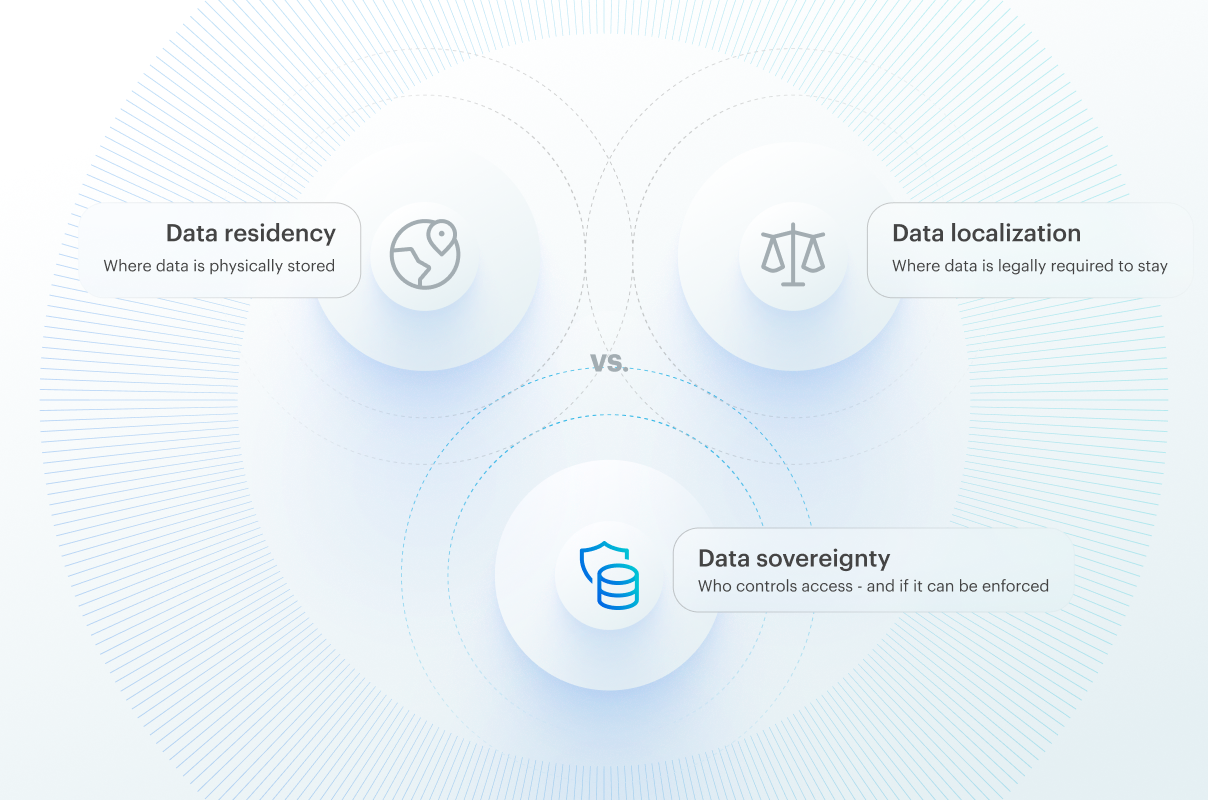
The terms “data sovereignty” and “data residency” are often used interchangeably in corporate contexts. However, they refer to different levels of data control – and confusing them can lead to a false sense of security.
Data residency: Where data is stored
Data residency refers to the physical location of data, typically the geographic location of data centers. Decisions around data residency are largely technical and organizational, influenced by cost, performance, and regulatory requirements. In many cases, data residency can help organizations comply with legal obligations and is closely related to data localization.
Data localization: Where data must stay
Data localization refers to legal requirements that mandate specific types of highly sensitive data - such as financial, healthcare, or public‑sector data - to be stored and processed within national borders.
Data sovereignty: Who controls the data
Data sovereignty focuses on who ultimately controls access to data, under which legal conditions access may occur, and whether that access can be technically restricted or prevented – especially in cross‑border or conflict scenarios.
Why jurisdiction matters more than location
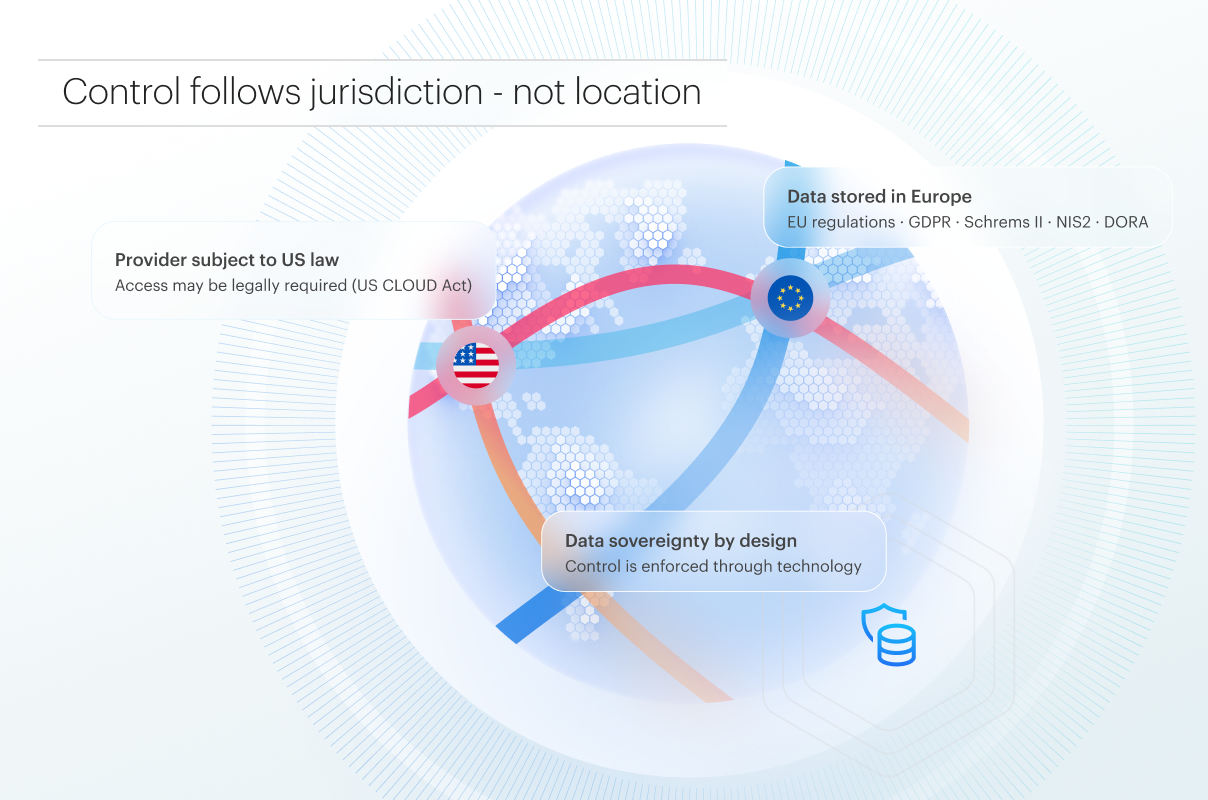
What ultimately determines control over data is the jurisdiction a provider is subject to – and therefore which laws apply to that provider and the data it processes. As a result, foreign legal obligations can override local storage and enable external access, even when data remains within a specific region.
Scenario 1: US jurisdiction despite EU data residency
A European bank stores customer account and transaction data in an EU‑based data center operated by a US cloud provider. Even though the data never leaves the EU, the provider remains subject to US law. Regulations such as the US CLOUD Act can legally require the provider to disclose data to US authorities upon request – regardless of where the data is physically stored.
Scenario 2: Legal obligations under Chinese law
A similar – but legally distinct – dynamic exists in China. Chinese data governance combines explicit data localization requirements with broad jurisdiction‑based access powers. If operated by a Chinese provider subject to Chinese law, authorities may claim access to certain categories of data, such as personal data or “important data”. This can apply where national security or public interests are at stake, even when that data is processed outside China or shared internationally.
Together, these scenarios highlight a critical reality: physical data location alone does not guarantee control when jurisdiction lies elsewhere. Organizations must understand not only where data is stored, but which legal access rights may apply.
What does this mean in practice?
Organizations that want to implement real data sovereignty must look beyond data center locations and contractual clauses. What matters is how legal frameworks, contractual safeguards, and technical controls work together. In practice, this often means using zero-knowledge architectures with end-to-end encryption, customer‑controlled key management, and granular access governance. These allow organizations to enforce control in technical terms.
Data sovereignty as a strategic advantage
For many organizations, data sovereignty shows up in everyday decisions: choosing a cloud provider, responding to an audit, or expanding into new markets. While maintaining control over data is the core objective of data sovereignty, its impact goes beyond protecting sensitive data or reducing compliance risks.
Organizations that can clearly demonstrate how – and by whom – their data is controlled send a strong signal to prospects, customers, partners, and regulators alike: sensitive information is handled responsibly, securely, and transparently. In an increasingly data-driven economy, this trust becomes a competitive advantage.
Want to stay in control of your data? We’d be happy to support your journey toward data sovereignty by design.
Share this article